Translating Your Website for the Canadian Market: Stakes and Pitfalls
Discover why a tailored localization strategy for the French-Canadian market is far more effective than a simple translation for converting online visitors.
Launching an e-commerce site or a corporate showcase in Canada requires a delicate balancing act between two entirely distinct markets: English-speaking Canada and Quebec (alongside other Francophone communities across the country).
If you already have an English version or a European French version of your site, do you really need to "translate" it again? In this context, we are taking about localization rather than pure translation, and the nuance is of utmost importance for your conversion rates.
The Difference Between Translation and Website Localization
Web translation simply transfers the meaning of a text from a source language (e.g., English) to a target language (French). It serves a functional purpose but remains culturally "neutral." This is typically the territory of machine translation software or agencies lacking local specialists. Web localization (L10n), on the other hand, is the expert process of adapting your content so that it naturally resonates with your target audience in a specific geographic area.In Canada, Quebec French is not the same as European French. Similarly, Canadian English differs from British or American English in terms of spelling and certain cultural conventions (like date formats).
Common Pitfalls in Web Translation for Canada
Many businesses, sometimes even massive corporations, bungle their entry into the Canadian market by making the following mistakes:
1. Using European French for the Quebec Market
If your expressions, syntax, or product descriptions sound "European," the Quebec consumer will automatically sense a disconnect with your brand. Using European expressions like "du coup", or Anglicisms common in France like "shopping" and "mail" (instead of "courriel") can break the bond of trust with a customer expecting a local service.
Example: A "mobile phone" is called a "portable" in France, but a "cellulaire" in Quebec.2. Neglecting Local SEO (Search Engine Optimization)
When a Canadian user searches on Google.ca, they use highly specific lexical habits. A translator who ignores the SEO dimension will simply translate the source word without verifying if it reflects the actual search intent and volume of Quebecers or English Canadians. Conducting SEO directly in the target language is absolutely vital.
3. Legal Specificities (Bill 96)
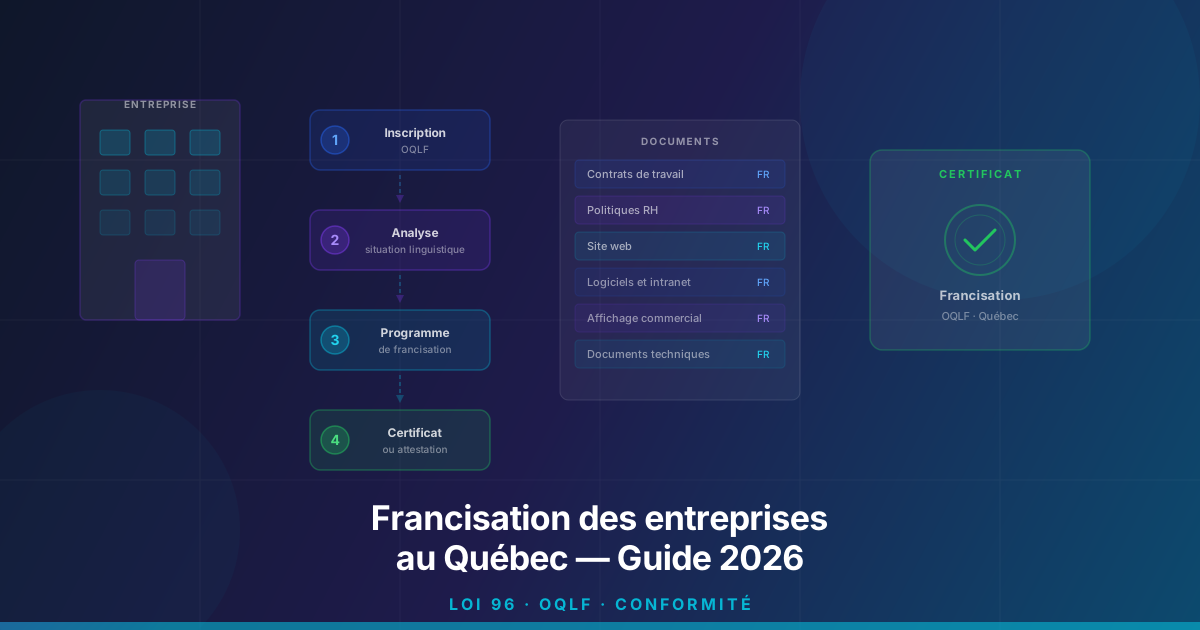
In Quebec, businesses are legally obligated, through the Charter of the French Language and Bill 96, to serve the public and present themselves digitally in a manner where French honors a predominant position. Comprehensive French-Canadian localization prevents potential complaints to the Office québécois de la langue française (OQLF) and projects the image of a brand that respects the province's citizens.
Key Elements of Proper Digital Localization
A high-performing localization agency will verify more than just plain text and product pages:
* Currency and Date Formats: The dollar sign is placed after the amount in Canadian French (e.g., `150,00 $` vs. `$150.00` in English). Date formats also switch from DD/MM/YYYY to YYYY-MM-DD.
* Backend Translation: 404 error messages, Terms and Conditions, contact forms, legal disclaimers, post-purchase transactional emails, and pop-ups must all be localized.
* Meta Tags and SEO Keywords: The Title and Description fields, as well as the alternative text (`alt text`) for images, contribute heavily to attracting qualified organic traffic.
Conclusion: Linguistic UX
Beyond simply understanding a message factually, the Canadian consumer seeks to identify with what they read on their desktop or mobile device. User Experience (UX) is not purely visual or ergonomic: it is fundamentally linguistic.
Entrust the translation and localization of your e-commerce or corporate website to specialists who truly measure the impact of cultural context on the success of a sales or marketing initiative.
---
FAQ – Website Translation in Canada
Do I need to translate my website if I operate internationally from Canada?
While English serves as an international "lingua franca," adapting a website or app into the target users' native language (French, German, Chinese, Japanese) systematically doubles or even triples foreign engagement rates and massively reduces bounce rates, according to multiple e-commerce studies.
Do AI tools or plugins like WPML translate websites well?
AI excels at speed and integrates easily, but it is not immune to bias or brand consistency issues. While a multi-language plugin sets up the technical foundation, it is always recommended to entrust the final review (and the adaptation of SEO terminology for the target country) to a human translator who is an expert in your field.
Get a Free Quote
Our certified translators are ready to help. Response within 2 hours.
Request a Quote →Related articles
Bill 96 Checklist for U.S. Exporters Selling into Quebec (2026)
A practical Bill 96 checklist for U.S. companies selling into Quebec: packaging, labels, websites, ads and trademarks — what French is required, and the fines for getting it wrong.
Why U.S. Companies Choose a Canadian Translation Agency in 2026
Canadian French ≠ France French. Why U.S. companies hire a Canadian translation agency: native Quebec French, Bill 96 compliance, CAD billing and nearshore time zones.