Certified Translation for Canadian Immigration (IRCC): The Complete Guide
Everything you need to know about IRCC requirements for the certified translation of your immigration documents in Canada.
When filing an application for immigration, a work permit, or permanent residency with Immigration, Refugees and Citizenship Canada (IRCC), the accuracy of your documents is absolutely critical. If your original supporting documents (birth certificates, diplomas, police records) are neither in English nor in French, you are strictly required to provide a certified translation.
But what precisely constitutes a valid certified translation in Canada? And how can you ensure your application won’t be returned due to a "non-compliant translation"? This guide covers everything you need to know.
Official IRCC Requirements
IRCC rules are inflexible and leave no room for error. If your supporting documents are in a foreign language, you must submit:
- A certified true copy of the original document.
- A certified translation of the document into English or French.
- An affidavit (a sworn declaration) by the translator only if they are not a member in good standing of a recognized Canadian translation association.
It is this third point that often complicates the process for many newcomers.
Why Choose a Certified Translator (OTTIAQ, ATIO, STIBC)?
In Canada, the title of "translator" is not protected at the federal level, but properly certified professionals belong to provincial regulatory bodies such as the Quebec (OTTIAQ) or Ontario (ATIO) regulatory associations.
Hiring a certified translator who is a member of one of these professional orders offers a major advantage: your certified translation meets IRCC's rule without needing to be notarized or accompanied by an affidavit. The official seal and membership number of the translator are sufficient.
This saves you:
- Notary or commissioner of oaths fees.
- Additional processing days.
- The risk of your application being rejected.
The Most Commonly Translated Documents for IRCC
Whether applying through Express Entry, family sponsorship, or a Provincial Nominee Program (PNP), the following documents systematically require a certified translation if they are not in English or French:
* Civil Status Documents: Birth certificates, marriage certificates, death certificates, divorce decrees.
* Legal Documents: Police certificates (criminal record checks).
* Academic & Professional Records: Diplomas, transcripts, letters of reference from former employers.
* Financial Documents: Bank statements proving available funds.
Fatal Mistakes to Avoid
* Translating your own documents: IRCC categorically refuses any translation done by the applicant or a family member (even if they are professional translators by trade).
* Using a foreign "low-cost" agency: An official translation lacking the stamp of a sworn or nationally recognized Canadian translator will require notarization by a Canadian notary or commissioner of oaths, thus negating any initial cost savings.
* Translating only partially: All seals, signatures, and foreign government stamps present on the original document MUST be translated or explicitly mentioned in the certified translation. Nothing can be omitted.
How Long Does a Certified Translation Take?
Thanks to digital workflows, the process is now highly efficient. At Asiatis, once a clear and secure scan of your document is submitted, the certified translation of a standard document (like a one-page birth certificate) typically takes between 2 to 3 business days. A 24-hour rush service is often available for tight deadlines.
The final translation is delivered electronically (PDF) bearing the translator’s official signature and cryptographic seal; IRCC accepts the PDF for online applications.
FAQ – Certified Immigration Translations
Does IRCC accept electronic certified translations?
Yes, since the digitization of applications, IRCC accepts secure PDF files containing the digital seal of a translator who is a member of a Canadian professional order like OTTIAQ or ATIO.
Do I need to mail my original documents?
No. A clean, flat, high-resolution scan (without glare or cut-off edges) of your original documents is sufficient to initiate the certified translation process.
If I am applying from Quebec, must the translation be done by an OTTIAQ member?
For federal immigration (IRCC), any translator who is a member of a Canadian provincial association (ATIO, OTTIAQ, STIBC) is recognized. However, for provincial procedures (e.g., permits for a Quebec professional order), OTTIAQ status is highly recommended, and often mandatory in Quebec.
---
To have your documents prepared to IRCC's published requirements, entrust your documents to our agency for a free quote. The experts at Asiatis will guide you through all your certified translation needs in Canada.
Get a Free Quote
Our certified translators are ready to help. Response within 2 hours.
Request a Quote →Related articles
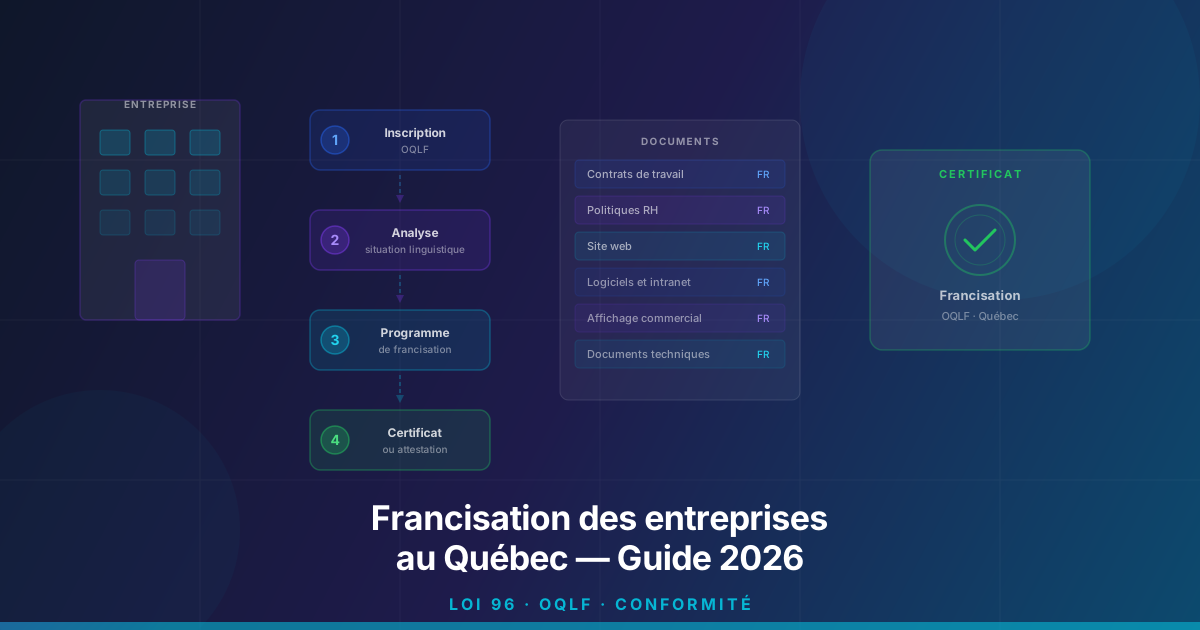
Bill 96 Checklist for U.S. Exporters Selling into Quebec (2026)
A practical Bill 96 checklist for U.S. companies selling into Quebec: packaging, labels, websites, ads and trademarks — what French is required, and the fines for getting it wrong.
Why U.S. Companies Choose a Canadian Translation Agency in 2026
Canadian French ≠ France French. Why U.S. companies hire a Canadian translation agency: native Quebec French, Bill 96 compliance, CAD billing and nearshore time zones.