Why Legal Translation Strictly Requires a Certified Translator
From translating contracts and corporate bylaws to wills: why the absolute accuracy of a certified translator is essential in legal translation.
When it comes to translating contracts, corporate bylaws, shareholder agreements, or patents, the impact of a misplaced comma or a vague term can be legally and financially disastrous.
In Canada, this context is made even more complex by the coexistence of two distinct legal systems: Common Law, which prevails in the majority of provinces (Ontario, British Columbia, etc.), and Civil Law, which is specific to Quebec.
In this article, we’ll explore why entrusting your legal documents to a translator certified by a professional order (like OTTIAQ or ATIO) is not merely a "bonus," but a critical strategic safeguard.
The Untranslatability of Certain Concepts
In the legal field, almost every term carries the weight of jurisprudence. A common error made by unspecialized translators (or generic Artificial Intelligence) is attempting a foolish, word-for-word translation.
However, a concept found in Common Law does not necessarily have a perfect equivalent in Quebec Civil Law or European Law. The very essence of expert legal translation is adapting different conceptual systems.
Consider the English term "trust". Quebec Civil Law utilizes the institution of the "fiducie". Yet, this "fiducie" and the Common Law trust are not 100% identical. An experienced legal translator knows exactly how to circumscribe the primary intent behind the word to protect a business from having a clause invalidated in court.
The Certified Translator's Seal: Proof in Court
In the event of litigation, a contract containing ambiguity in its translated version can spark a lengthy (and costly) dispute, as the courts will have to rule on the true intent of the parties.
Having your legal document certified by a member of the Ordre des traducteurs, terminologues et interprètes agréés du Québec (OTTIAQ) or ATIO brings:
- The Presumption of Integrity: The translation is signed by a professional accountable to their order, so its accuracy is rarely debated — the decision still rests with the court.
- Professional Liability Insurance: As members of a protected order, these professionals must carry liability insurance in the event that a fault or error causes financial harm.
- Strict Professional Secrecy: A sworn member is bound by the same degree of confidentiality and professional privilege protecting corporate data as a lawyer or public notary.
Is AI-Assisted Legal Translation Viable?
The rise of Large Language Models has tempted some companies into translating their "fine print" and Terms of Service (ToS) using free automated tools to cut budgets.
Unless you are knowingly courting financial risk: this is a terrible calculation. A machine cannot grasp the nuances of local law nor guarantee the legal equivalence of the text, frequently leaving loopholes that can be exploited by competitors or disgruntled clients.
However, large-scale professional agencies can now utilize Neural Machine Translation on the first pass (to process enormous volumes of evidentiary discovery materials), followed strictly by extensive and scrupulous post-editing by an expert human legal translator (MTPE). This lowers costs while maintaining excellent traceability and flawless legal precision.
FAQ – Translating Legal Documents in Canada
Must a commercial contract drafted in English be sworn in Quebec?
Since the full implementation of Bill 96, standard employment and consumer contracts for a business operating in Quebec must first and foremost be presented and signed in French, unless it is the explicit will of another party to co-sign it in English. If a head office outside Quebec initially imposes its English templates, the French translation must be rigorous to ensure full compliance with the OQLF!
Do contracts signed in bilingual Canada legally require both English and French versions?
No (aside from specific federal regulations and statutes). From a private and commercial contractual standpoint, a single language holds the force of law, provided it is mutually agreed upon. Often, a "Language of the Contract" clause stipulating that the parties expressly wish to use English (or French) is sufficient in most jurisdictions outside of Quebec.
However, if you are forming partnerships in Quebec, French is fundamental for your commercial relations and human resources on the ground.
---
At Asiatis, our legal translators and paralegals blend legal expertise with a mastery of linguistic subtleties. Get a quote to localize your contracts in Canada.
Get a Free Quote
Our certified translators are ready to help. Response within 2 hours.
Request a Quote →Related articles
Bill 96 Checklist for U.S. Exporters Selling into Quebec (2026)
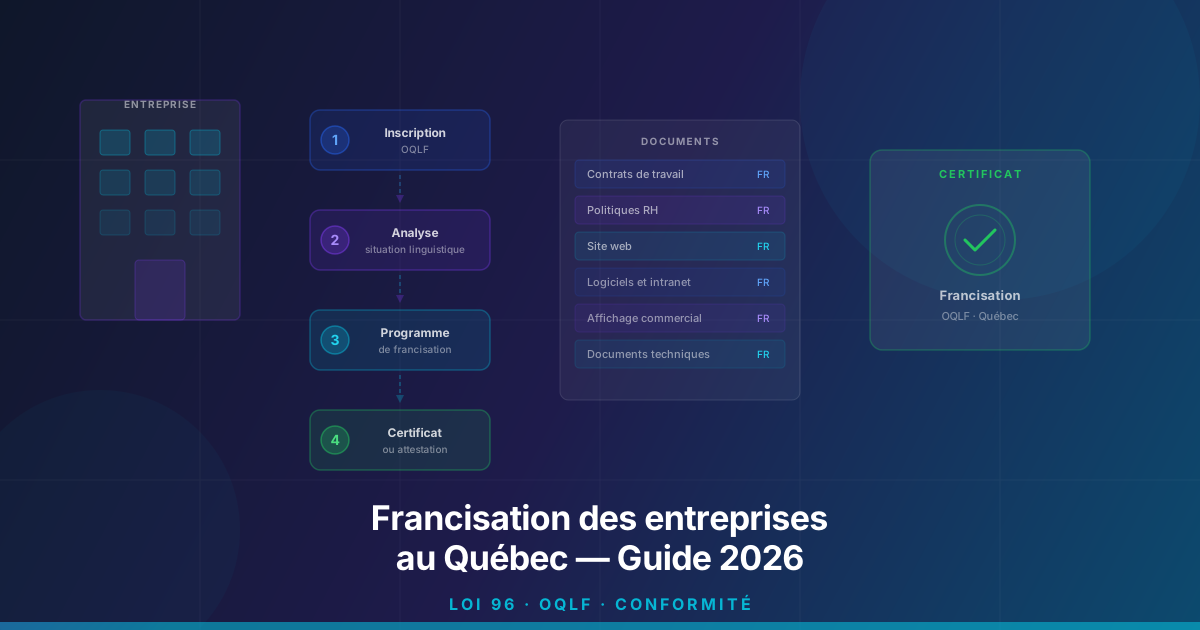
A practical Bill 96 checklist for U.S. companies selling into Quebec: packaging, labels, websites, ads and trademarks — what French is required, and the fines for getting it wrong.
Why U.S. Companies Choose a Canadian Translation Agency in 2026
Canadian French ≠ France French. Why U.S. companies hire a Canadian translation agency: native Quebec French, Bill 96 compliance, CAD billing and nearshore time zones.