Certified vs Sworn Translation in Canada: What's the Difference?
Canada uses certified translation, while France uses sworn translation. Learn the differences, recognition rules and what to choose for your file.
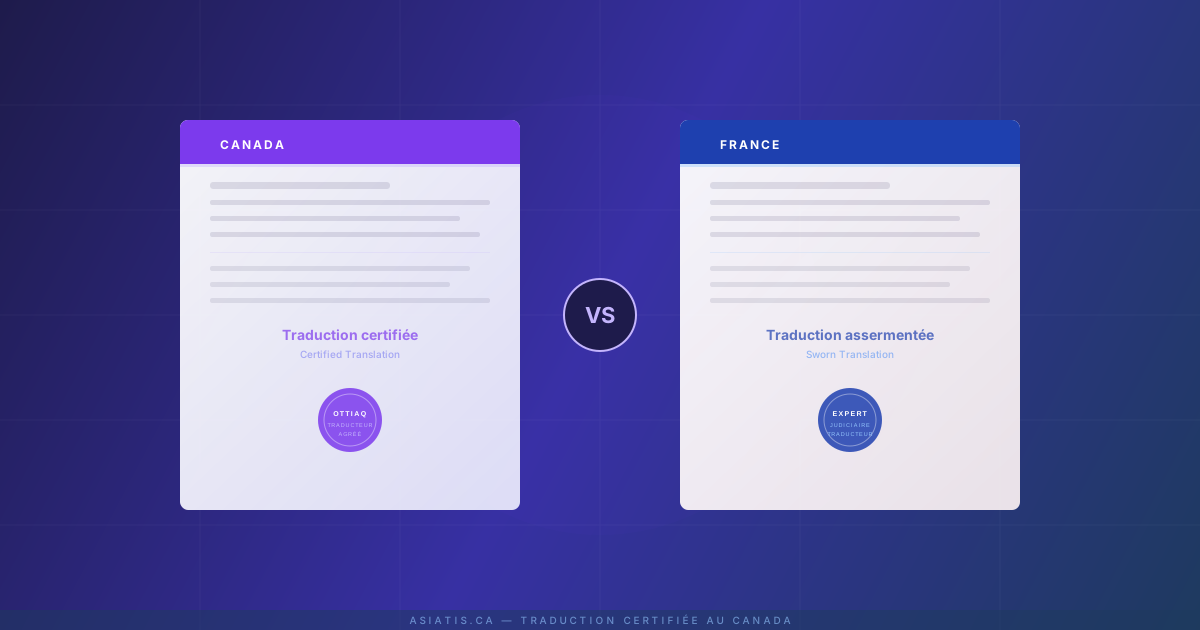
In Canada, the standard term is certified translation. In France, the equivalent concept is sworn translation (traduction assermentée). Both serve a similar purpose — producing a translation that is accepted in official contexts — but they are based on different systems and are not automatically interchangeable. The right choice depends on the country and the authority receiving your document.
In brief — In Canada, a certified translation is generally prepared by a certified translator who is a member of a provincial professional order such as OTTIAQ, ATIO, or STIBC. In France, a sworn translation is prepared by a court-appointed expert translator registered with a Court of Appeal or the Court of Cassation. Both systems serve a comparable function — producing a translation usable in an official context — but recognition depends on the receiving authority.
What Is a Certified Translation in Canada?
In Canada, a certified translation is the standard term for an official translation accompanied by a translator's declaration attesting to the accuracy and completeness of the translation.
The system is based on provincial professional orders that regulate the translation profession:
- Quebec — OTTIAQ (Ordre des traducteurs, terminologues et interprètes agréés du Québec). Certified translators affix their official seal and membership number.
- Ontario — ATIO (Association of Translators and Interpreters of Ontario). Certified translators use the "C.Tran." designation.
- British Columbia — STIBC (Society of Translators and Interpreters of British Columbia). Certified members affix their seal.
- Other provinces — provincial associations also exist in other Canadian regions.
Each certified translation generally includes:
- the complete translation of the original document;
- the translator's seal or signature;
- a certification statement attesting to the accuracy of the translation;
- the translator's membership number or professional status, depending on the order.
Many Canadian bodies ask for a certified translation, including IRCC, MIFI, universities, and courts, according to their respective requirements.
What Is a Sworn Translation in France?
In France, the standard term is sworn translation (traduction assermentée), performed by a court-appointed expert translator (expert judiciaire traducteur). The term "assermenté" (sworn) refers to a translator who has taken an oath before a Court of Appeal and is registered on the official list of judicial experts.
This system is specific to the French legal context:
- the sworn translator is registered on the lists of the Courts of Appeal or the Court of Cassation;
- they affix their seal, signature, and a sworn statement on each translation;
- the translation has official status before French administrations and courts.
The term "sworn translation" is standard in France, Belgium, and French-speaking Switzerland. If you have arrived from one of these countries and are looking for a "traduction assermentée" in Canada, you likely need a Canadian certified translation.
Are Certified and Sworn Translations Equivalent?
They serve a comparable function — producing a translation usable in an official context — but they are not automatically interchangeable.
What is similar:- in both cases, a qualified professional attests to the accuracy of the translation;
- in both cases, a seal and signature accompany the document;
- in both cases, the translation is intended for official use.
- the recognition system is different: professional order in Canada, Court of Appeal in France;
- recognition depends on the receiving authority: a Canadian administration is not obligated to accept a French sworn translation, and vice versa;
- some authorities may require additional formalities (affidavit, certified true copy, apostille) if the translation was prepared in another country.
Comparison Table: Canada vs France
| Criterion | Canada: certified translation | France: sworn translation |
|---|---|---|
| Common term | Certified translation | Sworn translation (traduction assermentée) |
| Professional | Accredited or certified translator by province | Court-appointed expert translator |
| Governing authority | Provincial professional order (OTTIAQ, ATIO, STIBC) | Court of Appeal or Court of Cassation |
| Seal and signature | Yes | Yes |
| Primary use | Canadian files: IRCC, MIFI, universities, courts | French administrations and courts |
| Recognition abroad | Verify with the receiving authority | Verify with the receiving authority |
| Apostille possible | Depending on applicable formalities | Depending on applicable formalities |
Which Translation Should You Choose for a Canadian File?
For a file submitted to a Canadian authority, a certified translation by a certified translator who is a member of a recognized Canadian professional order is generally the most appropriate choice.
By receiving authority:- IRCC — requires that documents not in English or French be accompanied by a translation that complies with applicable requirements. Depending on the case, a translator's affidavit may be required. See our complete IRCC guide.
- MIFI — requires a translation by a recognized translator, with their name and seal. For a Quebec-bound application, an OTTIAQ-certified translator is the safest choice. See our MIFI guide.
- Canadian universities — generally require a certified translation for foreign transcripts and diplomas.
- Canadian courts — requirements vary by jurisdiction.
For pricing details, see our guide to certified translation costs in Quebec.
Is a French Sworn Translation Accepted in Canada?
It depends on the receiving authority and the type of file.
IRCC, for example, requires that supporting documents be accompanied by a compliant translation. Specific requirements may vary by program and application type. In some cases, a translator's affidavit or a certified true copy may be required in addition to the translation itself.
A sworn translation prepared in France is not automatically equivalent to a Canadian certified translation for all Canadian organizations. To reduce the risk of rejection or correction requests, it is often preferable to obtain a certified translation that complies with Canadian requirements, especially for IRCC and MIFI files.
Recommendation: if your file is intended for Canada, have a certified translation prepared by a Canadian certified translator. See our certified translation page or our dedicated IRCC page.Is a Canadian Certified Translation Accepted in France?
It depends on the French administration or receiving authority.
Some French authorities may accept a foreign translation if it is accompanied by additional formalities (apostille, legalization). Others may require a sworn translation prepared by a court-appointed expert translator registered in France.
Points to verify:- does the French receiving authority accept foreign translations?
- is an apostille or legalization required?
- is a French sworn translation specifically required?
If your documents need to be used in France and you need a French sworn translation, the Asiatis group also has an entity in France — asiatis.com — that can direct you to the appropriate service within the French system.
What Role Does the Apostille Play Between Canada and France?
Canada has applied the Hague Apostille Convention since January 2024. The apostille authenticates certain public documents for use in another signatory country.
Key points:- the apostille does not replace the translation itself — it authenticates a document or certificate;
- in Quebec, certain formalities may require a lawyer or notary to certify the translation before it can be apostilled;
- the exact formalities depend on the document, the translation, and the destination country;
- a Canadian certified translation is not automatically apostillable without prior formalities.
For a complete guide to apostille in Canada, see our apostille article and our apostille and legalization service.
What About the United States?
The American system is different from both the Canadian and French systems. USCIS (U.S. Citizenship and Immigration Services) generally requires that documents in a language other than English be accompanied by a complete, certified English translation, including a translator's declaration attesting to their competence and the accuracy of the translation.
The American concept of "certified translation" is not identical to the Canadian or French system. If your documents are intended for the United States, consult the official USCIS instructions for the relevant program.
Can Asiatis Help with Both Systems?
Asiatis Canada supports clients who need a certified translation for a Canadian file:
- network of certified translators who are members of OTTIAQ and other recognized Canadian associations;
- experience with IRCC, MIFI, WES, university, and court files;
- coverage of over 40 languages;
- support for additional formalities (apostille, legalization).
For needs within the French system (sworn translation by a court-appointed expert), the Asiatis group has an entity in France — asiatis.com — that can direct you to the appropriate service.
A single point of contact can help you identify the right type of translation based on the destination country and receiving authority.
FAQ
Is a Canadian certified translation valid in France?
Not automatically. Some French authorities may accept a foreign translation with additional formalities (apostille, legalization), while others require a sworn translation prepared by a court-appointed expert translator registered in France. Always verify with the receiving authority.
Is a French sworn translation accepted by IRCC?
It depends on the file requirements. IRCC requires a translation that meets its applicable standards, and some cases may require an affidavit or certified true copy. A French sworn translation is not automatically equivalent to a Canadian certified translation for all IRCC programs.
What is the difference between an accredited and a certified translator?
In Canada, the terminology varies by province. In Quebec, the term is "certified translator" (traducteur certifié), a member of OTTIAQ. In Ontario, ATIO uses the "certified translator" (C.Tran.) designation. In both cases, the professional is recognized by a professional order or association.
Does the term "official translation" have a precise legal meaning in Canada?
It is a common term, but it does not have a single legal definition in Canada. What matters is what the receiving authority requires: a certified translation by a certified translator, an affidavit, a certified true copy, or another formality. Always check the specific program requirements.
Do I need an apostille to use a Canadian translation in France?
Sometimes, depending on the receiving authority and document type. The apostille does not replace the translation; it authenticates certain documents or certificates for use abroad. In Quebec, certain preliminary formalities may be required before apostille.
Does a Canadian certified translation expire?
The translation itself generally does not have an automatic expiry date. However, some organizations require recent documents — for example, police records or bank statements for immigration files may have a limited validity period.
If I need to use the same document in Canada and France, what should I order?
First identify the two receiving authorities and their respective requirements. In some cases, two separate translations or additional formalities may be necessary. Asiatis can help you determine the best approach.
Can Asiatis help me choose the right option?
Yes. Asiatis can analyze the destination country, the authority requesting the document, and the type of file to recommend the most appropriate approach — Canadian certified translation, French sworn translation, or both if necessary.
---
To find out which type of translation is right for your file, contact us for a free consultation. See also our certified translation page and our guide to apostille in Canada.
Get a Free Quote
Our certified translators are ready to help. Response within 2 hours.
Request a Quote →Related articles

Bill 96 Checklist for U.S. Exporters Selling into Quebec (2026)
A practical Bill 96 checklist for U.S. companies selling into Quebec: packaging, labels, websites, ads and trademarks — what French is required, and the fines for getting it wrong.
Why U.S. Companies Choose a Canadian Translation Agency in 2026
Canadian French ≠ France French. Why U.S. companies hire a Canadian translation agency: native Quebec French, Bill 96 compliance, CAD billing and nearshore time zones.