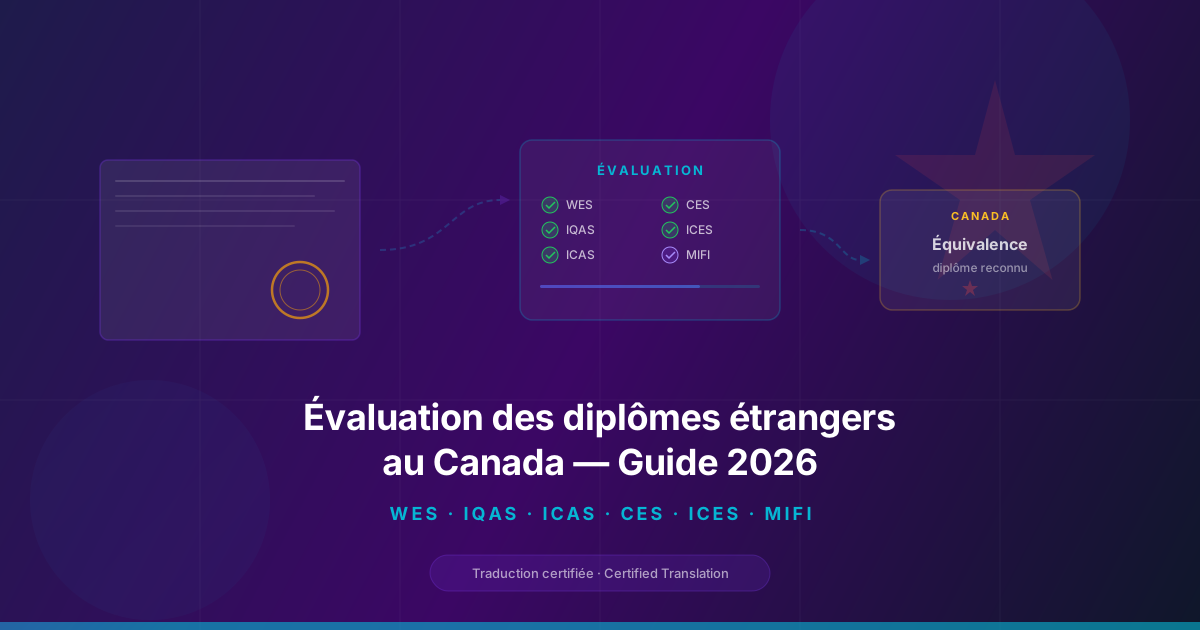
WES, IQAS, ICAS, CES, ICES: Complete Guide to Foreign Credential Evaluation in Canada in 2026
WES, IQAS, ICAS, CES, ICES: which organization should evaluate your foreign diploma in Canada? Process, certified translations, timelines and tips.
Getting a foreign diploma evaluated in Canada means comparing your credentials with the Canadian education system — but the right organization and process depend entirely on your goal: federal immigration, a Quebec program, university admission, employment, or a regulated profession.
In brief — To have a foreign diploma evaluated in Canada, you must first identify the purpose: federal immigration, Quebec, university, employer, or regulated profession. For Express Entry, IRCC requires an Educational Credential Assessment (ECA) from a designated organization such as WES, IQAS, ICAS, ICES, or CES. In Quebec, the MIFI's comparative evaluation serves a different purpose. If your diplomas or transcripts are not in English or French, a compliant translation may be required.
What Is a Foreign Credential Evaluation in Canada?
A foreign credential evaluation — known as an Educational Credential Assessment (ECA) — is a process that compares a diploma, certificate, or degree obtained outside Canada with the Canadian education system. The purpose is to determine the Canadian equivalent of your foreign credential.
This evaluation may be required in several contexts:
- federal immigration — IRCC requires an ECA for certain immigration programs, including Express Entry;
- Quebec programs — the MIFI issues a comparative evaluation of studies completed outside Quebec;
- university admission — some Canadian universities require an evaluation from a specific organization;
- employment — some employers verify foreign qualifications;
- regulated professions — professional regulatory bodies have their own evaluation and recognition requirements.
What Is the Difference Between ECA, WES, and Quebec's MIFI Comparative Evaluation?
These three terms are often confused, but they refer to different things.
ECA (Educational Credential Assessment) refers to the type of evaluation used for federal immigration purposes. IRCC requires that this evaluation be produced by a designated organization. There are five designated organizations and several designated professional bodies for specific professions. WES (World Education Services) is one of the five organizations designated by IRCC to produce ECAs. It is the most well-known, but it is not the only option and is not mandatory. The four other designated organizations produce reports that are equally accepted by IRCC. MIFI comparative evaluation — Quebec's ministère de l'Immigration, de la Francisation et de l'Intégration issues a comparative evaluation of studies completed outside Quebec. This evaluation serves a Quebec-specific purpose and is not the same as an ECA for IRCC. See our MIFI guide for details. Key points:- the MIFI comparative evaluation does not necessarily replace an ECA for a federal immigration file;
- an ECA for IRCC does not necessarily replace the requirements of a professional regulatory body;
- you must check the requirements of the specific program or authority before choosing an organization.
Which Organizations Evaluate Foreign Credentials for Canada?
IRCC designates five organizations for immigration ECAs, as well as designated professional bodies for certain professions.
| Organization | Primary role | Common use | Note |
|---|---|---|---|
| WES Canada | Credential evaluation | IRCC, studies, employment depending on context | Verify the type of report required |
| IQAS | Credential evaluation | IRCC, employment, studies depending on context | Alberta-based organization |
| ICAS | Credential evaluation | IRCC, studies, employment depending on context | Check current processing times |
| ICES | Credential evaluation | IRCC, studies, employment depending on context | BCIT service (British Columbia) |
| CES | Comparative Education Service | IRCC, studies, employment depending on context | University of Toronto service |
| MIFI | Comparative evaluation of studies | Quebec | Does not always replace an IRCC ECA |
| MCC | Specific profession | Medicine | Professional body designated by IRCC |
| PEBC | Specific profession | Pharmacy | Professional body designated by IRCC |
| CACB | Specific profession | Architecture | Professional body designated by IRCC |
Which Organization Should I Choose Based on My Goal?
The choice depends on the context of your file. Here are the main scenarios:
- Express Entry / IRCC — the evaluation must be produced by one of the five IRCC-designated organizations, or by a designated professional body if your profession requires it. See our IRCC guide.
- Quebec / MIFI — the comparative evaluation is issued by the MIFI. See our MIFI guide.
- University — check which organization the institution requires. Some universities accept WES, others require a specific organization or conduct their own evaluation.
- Employer — check what the employer accepts. Some employers do not require a formal evaluation.
- Regulated profession — contact the professional regulatory body in the province where you plan to practise. An ECA for IRCC does not replace this step.
- Medicine, pharmacy, architecture — IRCC designates specific professional bodies for certain professions. Check the requirements on the official IRCC page.
How Does a WES Canada Application Work?
Here are the main steps for a WES Canada evaluation. Other organizations follow a similar process but may differ in the details.
- Create an account on the WES Canada website.
- Choose the type of evaluation required — the report type varies depending on whether it is for immigration, studies, or employment.
- Check the requirements for your country and institution — WES publishes country-specific requirements.
- Have your documents sent directly by your institution if required by WES — requirements vary by country. Some countries require documents to go through an official intermediary.
- Prepare translations if your documents are not in English or French — WES requires compliant translations for documents not issued in one of these languages.
- Track your application online through the WES portal.
- Receive your evaluation report.
Do I Need to Translate My Diplomas and Transcripts for WES, IQAS, ICAS, or CES?
If your original documents are not in English or French, a translation is generally required by the evaluation organization.
WES Canada requires translations into English or French for documents not issued in one of these languages. WES accepts translations produced by a translator who is a member of a recognized professional association, or other formats depending on the country. See the WES translation requirements. Quebec / MIFI — documents for the comparative evaluation must be in French or English, or accompanied by a translation by a recognized translator. For a Quebec-bound application, an OTTIAQ-certified translator is the safest choice. Other organizations (IQAS, ICAS, ICES, CES) — each organization has its own translation requirements. Check the instructions on the official website of your chosen organization. Key points for translation:- translate the entire document, including seals, stamps, and official markings;
- avoid partial translations — an organization may reject an incomplete file;
- verify name and date consistency across all documents;
- keep the originals for any future requests.
See our diploma WES translation page and our academic transcript translation page.
How Much Does a Foreign Credential Evaluation Cost in Canada?
The total cost depends on several factors. Fees change regularly and must be verified on each organization's official website.
| Cost item | What may be charged |
|---|---|
| Credential evaluation | Fee from the chosen organization (WES, IQAS, ICAS, ICES, or CES) |
| Additional report | Depending on the number of recipients |
| Postal or electronic delivery | Depending on the organization and delivery option |
| Certified translation | Depending on the language, volume, and document format |
| Certified copies or notarization | Depending on the file |
| Apostille or legalization | Only if required by the recipient |
For a personalized certified translation quote, see our pricing guide or contact us.
How Long Does It Take to Get an ECA or Comparative Evaluation?
Processing times vary significantly depending on the organization, the country of origin, the issuing institution, document receipt, and the time of year.
Factors that can affect processing time:- the evaluation organization's processing time;
- the time required for your institution to send documents;
- document verification by official intermediaries in some countries;
- application volume at the time of submission;
- availability of certified translations.
What Documents Should I Prepare Before an Evaluation?
The exact list depends on the organization and the country of origin, but here are the most commonly requested documents:
- diploma or degree obtained;
- transcripts for each year of study or for the full program;
- completion certificates or attestations;
- identity documents (passport, ID);
- certified translations if documents are not in English or French;
- proof of name change if documents bear a different name from your passport;
- sealed envelopes or direct institutional delivery if required by the organization;
- certified copies if requested.
Special Cases: French, North African, African, or Chinese Diplomas
Requirements vary depending on the country of origin.
French diplomas — documents issued in French generally do not require translation into French, but a translation into English may be required if the evaluation organization or recipient requests it. Seals, annexes, or notations in another language may need separate translation. North African and Francophone African diplomas — diplomas issued in French are often accepted without linguistic translation, but seals, stamps, or notations in Arabic or another language may require translation. Document structures and authentication systems vary by country. Chinese diplomas — documents and authentication systems are specific. Verification through CHESICC is often required for diplomas from Mainland China. Documents in Chinese must be fully translated. See our article on Chinese translation in Canada for details. In all cases: do not assume that one organization is always better than another for a specific country. Check the specific requirements on the website of your chosen organization.What About Regulated Professions?
If you intend to practise a regulated profession in Canada — medicine, pharmacy, engineering, law, accounting, teaching, nursing, architecture — an ECA for immigration is not sufficient.
The distinction is fundamental:- an ECA for IRCC confirms the academic level of the diploma within the Canadian system;
- the professional regulatory body evaluates whether your education and experience qualify you to practise the profession in Canada.
- medicine — the Medical Council of Canada (MCC) for physicians;
- pharmacy — the Pharmacy Examining Board of Canada (PEBC) for pharmacists;
- architecture — the Canadian Architectural Certification Board (CACB) for architects.
For other regulated professions, contact the professional regulatory body in the province where you plan to practise. The CICIC provides a directory of regulatory bodies by profession and province.
How Can Asiatis Help?
Asiatis supports applicants in preparing their foreign credential evaluation files:
- certified diploma translation for WES, IQAS, ICAS, ICES, or CES;
- academic transcript translation and university attestations;
- verification of the target language required by the receiving organization;
- name and date consistency across all documents in the file;
- translation of seals, stamps, and official markings;
- translation of supporting documents (reference letters, employment attestations, powers of attorney);
- personalized quote after document review.
Asiatis covers over 100 languages, including Chinese, Arabic, Spanish, Portuguese, Hindi, Russian, and all European languages. See our certified translation page or our IRCC immigration page.
For files requiring IQAS translation or CES translation, Asiatis prepares translations according to each organization's requirements.
FAQ
Is WES mandatory for Express Entry?
No. IRCC requires an Educational Credential Assessment (ECA) from a designated organization in certain cases, but WES is only one of five options. IQAS, ICAS, ICES, and CES are also accepted by IRCC.
What is the difference between WES and ECA?
ECA (Educational Credential Assessment) refers to the type of evaluation used for federal immigration. WES is one of the organizations that can produce this type of report, but it is not the only one.
Does the MIFI accept WES?
The MIFI comparative evaluation is a separate process, specific to Quebec. It should not be confused with an IRCC ECA. If a Quebec program requires the MIFI's comparative evaluation, a WES report does not necessarily replace it. Check the program requirements.
Do I need to translate a diploma that is already in French?
Not always. If the document is entirely in French and the receiving organization accepts French, no translation is needed. However, some seals, annexes, transcripts, or related documents may contain notations in another language that must be translated.
Does WES require transcripts sent directly by the university?
Often, but requirements vary by country, institution, and document type. Some countries require documents to go through an official intermediary. Always check WES instructions specific to your country before starting.
How long does an ECA remain valid?
For IRCC, the ECA must be valid when you create your Express Entry profile and when you submit your permanent residence application. The current validity period is less than 5 years. Check the official IRCC guidelines.
Can I use the same report for IRCC and a university?
Not always. A university may require a different type of report or a specific organization. Check the institution's requirements before ordering a report.
How much does it cost to translate a diploma and transcript?
The price depends on the source language, volume, format, and desired turnaround time. Asiatis provides a personalized quote after reviewing the document. See our pricing guide.
What should I do if the organization rejects my documents?
You need to identify the reason for rejection: incorrect format, missing or incomplete translation, non-compliant delivery by the institution, incomplete document, or country-specific requirement not met. A correction can then be prepared based on the reason for rejection.
Can Asiatis translate my documents for WES, IQAS, or CES?
Yes. Asiatis can translate diplomas, transcripts, and academic documents according to the requirements of the file and the receiving organization. Contact us for a personalized quote.
---
For a personalized quote for translating your diplomas and transcripts, contact us. See also our diploma WES translation page, our academic transcript translation page, and our certified translation page.
Get a Free Quote
Our certified translators are ready to help. Response within 2 hours.
Request a Quote →Related articles
Bill 96 Checklist for U.S. Exporters Selling into Quebec (2026)
A practical Bill 96 checklist for U.S. companies selling into Quebec: packaging, labels, websites, ads and trademarks — what French is required, and the fines for getting it wrong.
Why U.S. Companies Choose a Canadian Translation Agency in 2026
Canadian French ≠ France French. Why U.S. companies hire a Canadian translation agency: native Quebec French, Bill 96 compliance, CAD billing and nearshore time zones.