Chinese Translation in Canada: Mandarin, Cantonese, Simplified and Traditional Chinese — Complete 2026 Guide
Mandarin or Cantonese? Simplified or Traditional Chinese? A complete guide to choosing the right Chinese translation in Canada by document, region and recipient.
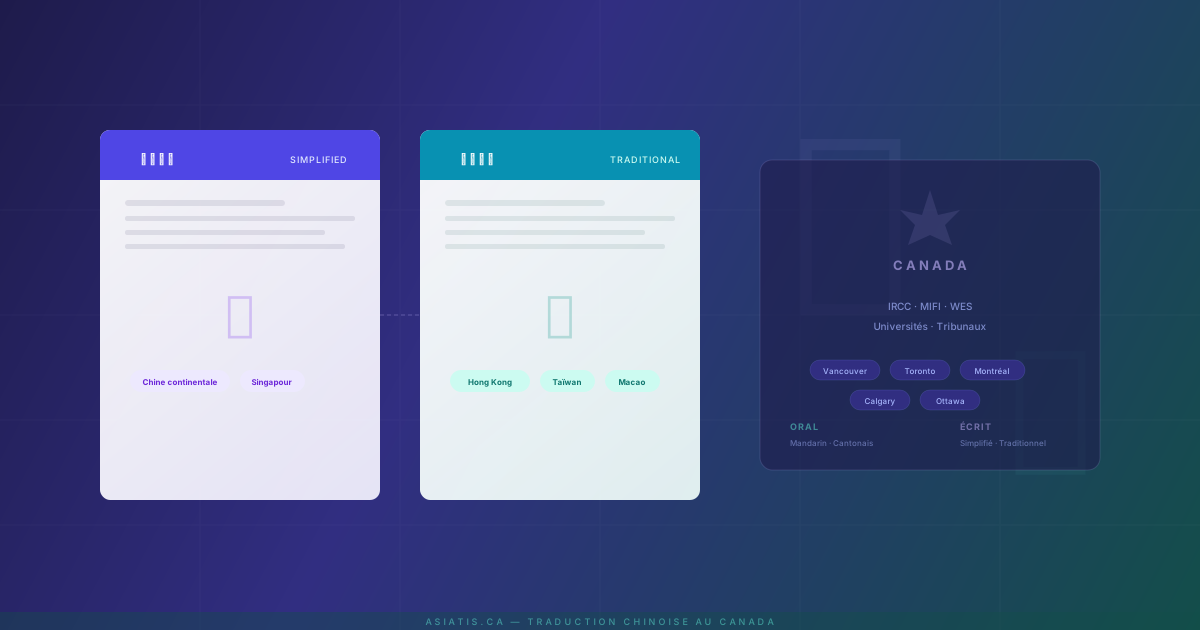
Choosing a "Chinese" translation in Canada involves more than selecting a single language. You need to determine the right spoken variety — Mandarin, Cantonese, or another — and the appropriate writing system — Simplified or Traditional Chinese — based on the document, the country of origin, and the receiving authority.
In brief — For a Chinese translation in Canada, you must distinguish spoken language from writing system. Mandarin and Cantonese are different spoken varieties, while Simplified and Traditional Chinese are two writing systems. The right choice depends on the country or region of origin of the document, the recipient, and the context: IRCC, MIFI, WES, university, court, or business partner.
Is Chinese Really a Single Language?
The term "Chinese" actually refers to a family of Sinitic languages comprising several distinct varieties, including Mandarin, Cantonese, Hokkien (Min Nan), Hakka, Shanghainese (Wu), and others. These varieties are not always mutually intelligible when spoken.
What unites them is the writing system: Chinese characters enable shared written communication, even between speakers of different spoken varieties. This is why, in written translation, the choice of writing system — Simplified or Traditional — is often more important than the spoken variety.
In Canada, Mandarin and Cantonese are the two most commonly requested varieties for translation and interpretation, reflecting the major Chinese-Canadian communities across the country. According to Statistics Canada census data, Chinese languages are among the most widely spoken non-official languages in the country.
What Is the Difference Between Mandarin and Cantonese?
Mandarin and Cantonese are two distinct spoken varieties of Chinese. They differ in pronunciation, number of tones, vocabulary, and some grammatical structures.
| Criterion | Mandarin | Cantonese |
|---|---|---|
| Main regions | Mainland China, Taiwan, Singapore, recent diaspora | Hong Kong SAR, Macao, Guangdong, historical diaspora |
| Number of tones | 4 tones + neutral tone | 6 to 9 tones depending on analysis |
| Official name (China) | Pǔtōnghuà (普通话) | Yuèyǔ (粤语) |
| Common name (Taiwan) | Guóyǔ (國語) | — |
| Mutual intelligibility | Not intelligible with Cantonese orally | Not intelligible with Mandarin orally |
| Common romanization | Pinyin | Jyutping |
Simplified or Traditional Chinese: Which to Choose?
Simplified and Traditional Chinese are two writing systems, not two languages. The choice depends on the destination or the intended reader of the document.
| Criterion | Simplified Chinese (简体) | Traditional Chinese (繁體) |
|---|---|---|
| Main regions | Mainland China, Singapore | Hong Kong SAR, Taiwan, Macao |
| Stroke count | Reduced (1950s–1960s reform) | Full historical form |
| Example: "language" | 语 | 語 |
| Example: "country" | 国 | 國 |
| Diaspora usage | Recent immigrants from Mainland China | Historical communities, Hong Kong SAR, Taiwan |
- your document is from Mainland China → Simplified Chinese;
- your document is from Hong Kong SAR, Taiwan, or Macao → Traditional Chinese;
- you are translating into Chinese for a partner in Shanghai → Simplified;
- you are translating into Chinese for a partner in Taipei or Hong Kong SAR → Traditional.
Which Chinese to Use by Country or Region?
| Region or recipient | Dominant spoken variety | Generally expected writing system | Note |
|---|---|---|---|
| Mainland China | Mandarin (pǔtōnghuà) | Simplified | Standard administrative and commercial use |
| Hong Kong SAR | Cantonese, English, Mandarin depending on context | Traditional | Major legal and financial market |
| Taiwan | Taiwanese Mandarin (guóyǔ) | Traditional | Terminology sometimes differs from Mainland China |
| Macao | Cantonese, Portuguese, Mandarin depending on context | Traditional | Chinese-Portuguese bilingual context |
| Singapore | Mandarin, English | Simplified | Distinct market |
| Canadian diaspora | Mandarin or Cantonese | Simplified or Traditional | Depends on generation and family origin |
Which Chinese Documents Are Most Commonly Translated in Canada?
Chinese-Canadian communities need to translate a wide variety of official documents, particularly for immigration, education, legal proceedings, and business.
Civil status and identity documents:- birth certificate (出生证明 — chūshēng zhèngmíng) — certified birth certificate translation
- marriage certificate (结婚证 — jiéhūn zhèng) — marriage certificate translation
- divorce certificate — divorce decree translation
- hukou / household registration (户口本 — hùkǒuběn)
- identity card (身份证 — shēnfènzhèng) — passport and ID translation
- police record (无犯罪记录证明 — wú fànzuì jìlù zhèngmíng) — police record translation
- diplomas and transcripts — diploma WES translation
- university certificates — academic transcript translation
- reference letters
- employment attestations — employment letter translation
- commercial contracts — Chinese contract and legal translation
- articles of incorporation — Chinese commercial document translation
- court judgments and powers of attorney — power of attorney translation
- notarized documents
Which Chinese Translations Are Needed for IRCC, MIFI, or WES?
The main Canadian authorities require that documents not in English or French be accompanied by a translation that meets their respective requirements.
IRCC — Chinese documents submitted as part of an immigration application must be translated into English or French. Depending on the file, a translator's affidavit may be required. Names must be transliterated consistently with the passport and other official documents. See our complete IRCC guide. MIFI — documents for Quebec programs (CSQ, Arrima, PEQ) must be translated by a recognized translator, with their name and seal. For a Quebec-bound application, an OTTIAQ-certified translator is the safest choice. See our MIFI guide. WES Canada — credential evaluation requires certified copies and translations of Chinese diplomas and transcripts. Documents from Mainland China generally need to go through the China Higher Education Student Information and Consultation Center (CHESICC / 学信网). See our diploma WES translation page. Key points for Chinese documents:- source document legibility is critical: handwritten documents or older hukou may require special handling;
- name consistency between the passport, birth certificate, and other documents is verified by authorities;
- red seals (印章) from Chinese notary offices must be translated and identified in the translation.
How Much Does a Certified Chinese-to-English or Chinese-to-French Translation Cost in Canada?
The price of a Chinese translation in Canada depends on several factors: the document type, the language combination, the volume, the legibility of the source document, and the desired turnaround time.
| Document type | Pricing method | Indicative turnaround |
|---|---|---|
| Birth certificate | Flat rate or quick quote | Depends on language and legibility |
| Hukou / household registration | Quote based on page count | Depends on volume |
| Diploma or transcript | Quote | Depends on page count |
| Police record | Flat rate or quick quote | Depends on format |
| Commercial contract | Quote per word or per project | Depends on volume and complexity |
Chinese may require more specialized expertise than some European languages, due to the differences between writing systems, regional terminology, and the complexity of certain official Chinese documents. For a personalized quote, see our pricing guide or contact us.
Why Does Regional Terminology Matter So Much?
The same concept may be expressed differently in Simplified Chinese (Mainland China) and Traditional Chinese (Hong Kong SAR, Taiwan). These are not just character differences: the terminology itself varies.
Some examples:| Term | Mainland China (Simplified) | Taiwan (Traditional) | Hong Kong SAR (Traditional) |
|---|---|---|---|
| Computer | 计算机 (jìsuànjī) | 電腦 (diànnǎo) | 電腦 (diànnǎo) |
| Software | 软件 (ruǎnjiàn) | 軟體 (ruǎntǐ) | 軟件 (ruǎnjiàn) |
| Internet | 互联网 (hùliánwǎng) | 網際網路 (wǎngjìwǎnglù) | 互聯網 (hùliánwǎng) |
A qualified Chinese translator must understand the terminological conventions of the target region, not just the characters.
What Chinese Services Does Asiatis Offer in Canada?
Asiatis Canada supports clients with their Chinese translation needs across several areas:
- certified translation of official documents for IRCC, MIFI, WES, universities, and courts — certified translation
- legal translation of contracts, judgments, powers of attorney, and notarized documents — Chinese contract and legal translation
- commercial translation of articles of incorporation, financial reports, and business documents — Chinese commercial translation
- technical translation of manuals, product sheets, and industrial documentation
- website localization for the Simplified or Traditional Chinese market — website translation
- interpretation in Mandarin and Cantonese — for interpretation needs, contact us to be directed to the right professional
Asiatis covers both Simplified and Traditional Chinese, as well as Chinese-to-English and Chinese-to-French language combinations. For more details, see our Mandarin Chinese language page.
How to Choose a Chinese Translator in Canada?
Not all Chinese translators have the same specialization. Here are the key criteria:
- proficiency in both writing systems — Simplified and Traditional — and knowledge of appropriate regional terminology;
- experience with official Chinese documents — hukou, birth certificates, notary seals, specific administrative formats;
- name and transliteration consistency — an experienced translator verifies that names are consistent between the passport, birth certificate, and other documents, using the appropriate romanization system (Pinyin for Mandarin, Jyutping for Cantonese);
- confidentiality — personal and legal documents require strict confidential handling;
- specialization — legal, technical, academic, or commercial depending on the need;
- ability to work into Canadian English or Canadian French — a translator who works into British English or European French may not use Canadian legal terminology.
How Long Does It Take to Translate a Chinese Document?
The turnaround depends on the document type, volume, and availability of the specialized translator:
- short documents (birth certificate, police record): often processed quickly, depending on availability;
- complete files (multiple documents for IRCC or WES): several days depending on volume;
- legal, technical, or handwritten documents: longer turnaround due to complexity;
- rush service: possible depending on availability, with a potential surcharge.
Handwritten or older Chinese documents may require additional processing time due to legibility. Always provide the clearest copies possible.
FAQ
What is the difference between 中文 and 普通话?
中文 (zhōngwén) generally refers to the Chinese language or Chinese writing in a broad sense. 普通话 (pǔtōnghuà) specifically refers to Standard Mandarin as used in Mainland China. In Taiwan, Standard Mandarin is called 國語 (guóyǔ).
My document is from Hong Kong SAR: should I use Traditional or Simplified Chinese?
Documents from Hong Kong SAR generally use Traditional Chinese. However, the translation must first faithfully reflect the source document as written, then meet the requirements of the recipient.
Is Cantonese a written language?
Cantonese is primarily a spoken language, but written Cantonese does exist, particularly in Hong Kong SAR in the press and informal communications. For official documents, standard written Chinese (Traditional in Hong Kong SAR) is generally used.
Does Asiatis translate Chinese documents for IRCC?
Yes, Asiatis can translate Chinese documents (Simplified or Traditional) for IRCC files, according to the applicable program requirements. You need to provide legible and complete copies of all documents.
Which writing system should I choose for Taiwan?
Taiwan generally uses Traditional Chinese. The terminology may differ from both Mainland China and Hong Kong SAR. An experienced translator familiar with the Taiwanese market will use the appropriate terminology.
Should Chinese names be translated or transliterated?
Names are generally transliterated, not translated. The transliteration must be consistent with the system already used in official documents, such as the passport. Consistency across all documents is verified by Canadian authorities.
Do I need to apostille a Chinese document to use it in Canada?
It depends on the document type, the issuing country, and the receiving authority. Translation does not replace authentication or apostille if required. See our guide to apostille in Canada.
How much does it cost to translate a Chinese document?
The price depends on the document, the target language, the writing system, the volume, and the turnaround time. A personalized quote is needed after reviewing the document. See our pricing guide.
---
For a personalized quote for your Chinese translation, contact us. See also our Mandarin Chinese language page and our certified translation page.
Get a Free Quote
Our certified translators are ready to help. Response within 2 hours.
Request a Quote →Related articles

Bill 96 Checklist for U.S. Exporters Selling into Quebec (2026)
A practical Bill 96 checklist for U.S. companies selling into Quebec: packaging, labels, websites, ads and trademarks — what French is required, and the fines for getting it wrong.
Why U.S. Companies Choose a Canadian Translation Agency in 2026
Canadian French ≠ France French. Why U.S. companies hire a Canadian translation agency: native Quebec French, Bill 96 compliance, CAD billing and nearshore time zones.