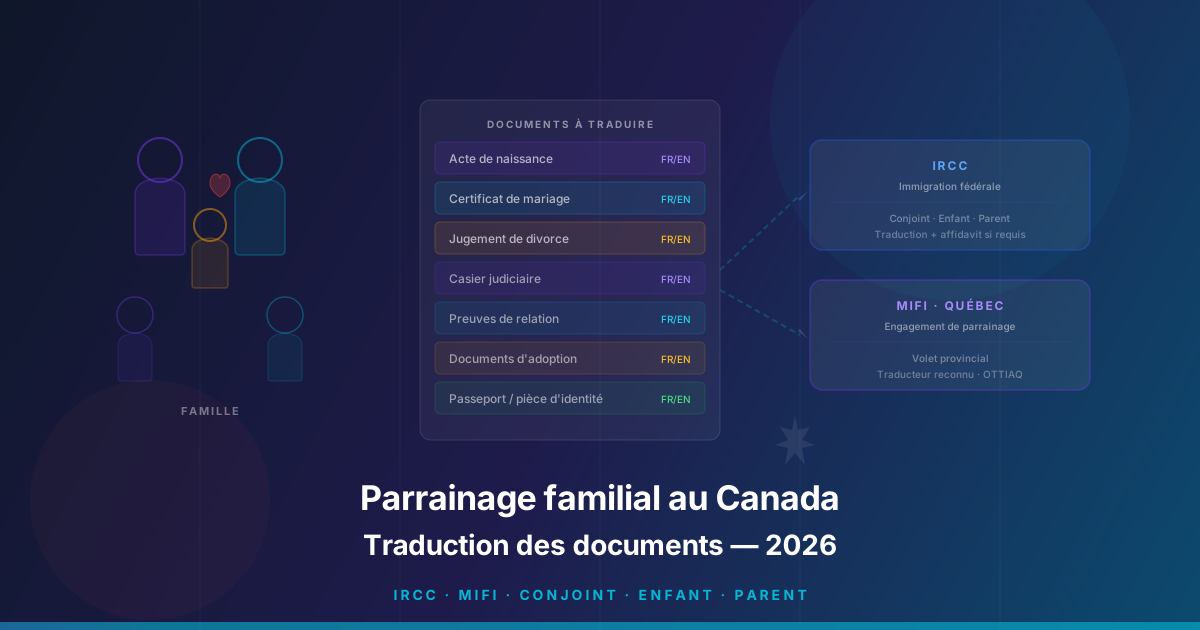
Family Sponsorship in Canada in 2026: Spouse, Child, Parent — Complete Document Translation Guide
Spousal, child, parent or grandparent sponsorship: which documents need translation for IRCC and MIFI? Practical certified translation guide.
Family sponsorship allows a Canadian citizen or permanent resident to sponsor certain family members for permanent residence in Canada. A strong application depends heavily on civil status, legal, and relationship documents that are properly prepared — and translated when they are not in English or French.
In brief — In a Canadian family sponsorship application, documents submitted to IRCC or to Quebec's MIFI must generally be in English or French. When a birth certificate, marriage certificate, divorce decree, police clearance, or family document is in another language, a compliant translation is required. In Quebec, an undertaking application to the MIFI may also be required in addition to the federal process.
What Is Family Sponsorship in Canada?
Family sponsorship is an IRCC program that allows a Canadian citizen or permanent resident to sponsor certain family members for permanent residence. It is distinct from economic immigration programs such as Express Entry or Provincial Nominee Programs.
The categories of people who can be sponsored include:
- a spouse;
- a common-law partner;
- a conjugal partner;
- a dependent child;
- a parent or grandparent.
A sponsorship application relies on documentary proof of the family relationship. Translating documents that are not in English or French is often a key part of the preparation process.
For IRCC's general translation requirements, see our complete guide to certified translation for Canadian immigration.
Who Can Sponsor and Who Can Be Sponsored?
Eligibility conditions are defined by IRCC and must be verified on Canada.ca. Here is an overview of the main categories and the documents to watch for:
| Category | Person sponsored | Key documents |
|---|---|---|
| Spouse | Legally recognized marriage | Marriage certificate, previous divorces, proof of relationship |
| Common-law partner | Conjugal relationship and cohabitation for at least 12 months | Proof of cohabitation, shared finances, correspondence |
| Conjugal partner | Long-term relationship with significant barriers to cohabitation or marriage | Relationship evidence, detailed explanations |
| Dependent child | Eligible child as defined by IRCC | Birth certificate, custody, parental consent, adoption |
| Parent or grandparent | Subject to PGP rules | Family link, sponsor's finances, identity documents |
What Is the Difference Between a Spouse, Common-Law Partner, and Conjugal Partner?
IRCC distinguishes three types of conjugal relationships, each with distinct documentary requirements:
Spouse — a legally recognized marriage in the country where it took place and in Canada. The main document is the marriage certificate. If either spouse was previously married, a divorce decree or death certificate of the former spouse may be required. Common-law partner — two people who have lived together in a conjugal relationship for at least 12 consecutive months. The evidence is often more extensive: shared leases, joint bank accounts, correspondence, photos, witness statements. Conjugal partner — a long-term relationship in which the partners are unable to live together or marry due to significant barriers (immigration, sexual orientation in certain countries, etc.). The evidence must explain the barriers and demonstrate the relationship. For translation: in all three cases, any document produced in a language other than English or French must be accompanied by a compliant translation. Relationship evidence containing relevant text (messages, letters, financial documents) may also need translation of the relevant excerpts.Which Documents Need Translation for Spousal Sponsorship?
Here are the documents most frequently requiring translation in a spousal sponsorship application, when they are not in English or French:
- birth certificate — of the sponsor and the sponsored person — birth certificate translation;
- marriage certificate — marriage certificate translation;
- divorce decree or death certificate of a previous spouse — divorce decree translation;
- police clearance certificate — format and content vary by country — police record translation;
- passport or identity document — if requested by IRCC — passport translation;
- military documents — if applicable;
- affidavits or witness statements — when written in another language;
- relationship evidence containing relevant text — emails, messages, leases, invoices, shared financial documents.
Which Documents Need Translation for a Dependent Child or Adoption?
For a dependent child, the main documents to translate (if not in English or French) include:
- birth certificate — birth certificate translation;
- custody order or shared custody agreement;
- parental consent from the other parent, if applicable;
- parents' divorce decree, if relevant to custody;
- adoption documents — adoption document translation;
- school or medical records, only if requested by IRCC.
For international adoptions, documentary requirements may be more complex and involve documents from multiple countries.
Which Documents Need Translation for Parents and Grandparents?
IRCC is not accepting new applications under the Parents and Grandparents Program (PGP) as of January 1, 2026, until further notice. The PGP operates through invitation rounds, and its rules and schedule are determined by IRCC. Check the current program status on Canada.ca.
When the program is active, the following documents may require translation if they are not in English or French:
- birth certificates proving the family link between the sponsor and the parents/grandparents;
- marriage certificates;
- police clearance certificates, if requested;
- identity documents (passports, national ID cards);
- sponsor's financial documents — often already in English or French if issued in Canada.
What Changes in Quebec with the MIFI Sponsorship Undertaking?
In Quebec, the family sponsorship process includes a federal component (IRCC) and a provincial component (MIFI). When IRCC determines that the sponsor is eligible, an undertaking application to the MIFI may be required before the permanent residence application can be finalized.
Current situation: the MIFI has reached the maximum number of undertaking applications for certain family reunification categories for the period from June 26, 2024 to June 25, 2026. Undertaking applications for the affected categories are not being accepted during this period. Check the current status on Québec.ca. Important: this does not mean the federal IRCC process is closed. IRCC continues to process federal sponsorship applications. It is recommended that you submit your application to IRCC without waiting, and monitor MIFI communications for the reopening of intake periods. For translations: documents submitted to the MIFI in a language other than English or French must be accompanied by a compliant translation. For a Quebec application, a translation by an OTTIAQ-certified translator is generally the safest and most appropriate option for the MIFI context.For detailed MIFI requirements, see our complete guide to certified translation for the MIFI.
What Are IRCC's Translation Requirements?
When a supporting document is not in English or French, IRCC generally requires:
- a certified true copy of the original document;
- a complete, word-for-word translation into English or French;
- if the translator is not a member of a recognized professional translation association in Canada, an affidavit from the translator may be required.
The translation must be complete: seals, signatures, stamps, handwritten notes, and annotations on the original document must be translated or noted.
For IRCC's general rules, see our guide to certified translation for IRCC.
How Long Does Family Sponsorship Take?
Processing times vary depending on the sponsorship category, the country of residence of the sponsored person, the complexity of the application, and any additional requests from IRCC.
IRCC publishes an official processing time tool: check processing times.
Key points:- processing times change regularly;
- an incomplete application or missing translations can cause delays;
- in Quebec, the MIFI component adds to the federal process and may extend the total timeline;
- preparing translations in advance helps avoid preventable delays.
How Much Does It Cost to Translate a Sponsorship Application?
The cost depends on the number of documents, the source language, the length, the urgency, and the document type.
| Document type | What affects the price |
|---|---|
| Birth or marriage certificate | Language, format, legibility |
| Divorce decree | Number of pages, legal complexity |
| Police clearance certificate | Country, format, seals and annotations |
| Relationship evidence | Volume, selection of relevant excerpts |
| Adoption documents | Number of items, country and Quebec requirements |
| Complete application | Total volume, urgency, terminology consistency |
How to Avoid Translation-Related Delays
Here are the most common mistakes that delay a sponsorship application:
- not checking the IRCC document checklist before preparing documents;
- submitting partial translations — seals, stamps, and handwritten notes must be translated;
- waiting until the end of the process to translate key documents — start as early as possible;
- name and date inconsistencies between translated documents — a professional translator ensures terminology consistency;
- not keeping digital copies of translations and originals;
- not anticipating additional IRCC requests — keep your documents ready;
- confusing machine translation with compliant translation — civil status, legal, and official documents should be handled by professionals.
How Can Asiatis Support a Family Sponsorship Application?
Asiatis supports families with the documentary preparation of their sponsorship application:
- review of the document file to identify items requiring translation;
- certified translation of civil status documents (birth, marriage, divorce, death certificates);
- translation of custody orders, adoption documents, and police clearances;
- translation of affidavits and witness statements;
- translation of selected relationship evidence (message excerpts, correspondence, financial documents);
- terminology consistency for names, dates, and places across all documents;
- strict confidentiality for all personal documents;
- personalized quote before work begins.
Asiatis is a translation and documentary support partner. For eligibility questions or immigration strategy, consult IRCC, the MIFI, or an authorized immigration advisor.
Contact us for a personalized quote. See also our certified translation for immigration page and our immigration services.FAQ
Do all documents in a sponsorship application need to be translated?
No. Documents that are already in English or French generally do not need translation. Only documents in another language must be accompanied by a compliant translation as required by IRCC or the MIFI.
Is an OTTIAQ-certified translation accepted by IRCC?
Yes. A translation by a certified translator who is a member of a recognized Canadian professional body (OTTIAQ, ATIO, STIBC) is generally accepted by IRCC without an additional affidavit. Check the instructions applicable to your application.
Do I need to translate WhatsApp messages or emails?
Not necessarily in full. It is often better to select the relevant excerpts that demonstrate the relationship, then have them translated clearly. A complete translation of entire conversations is generally not required.
Is my religious marriage certificate sufficient?
It depends on the civil recognition of the marriage and the rules of the country where it was celebrated. IRCC generally requires proof of a legally recognized marriage. Check the instructions for your application.
What if a document contains multiple languages?
All relevant parts that are not in English or French must be translated, including seals, stamps, and important annotations.
Does Quebec require additional documents?
Yes, in many cases the process includes an undertaking application to the MIFI. The MIFI has its own documentary and translation requirements. See our MIFI guide and check the requirements on Québec.ca.
Is the PGP open in 2026?
IRCC is not accepting new applications under the Parents and Grandparents Program as of January 1, 2026, until further notice. Check the program status on Canada.ca.
Is an apostille required for family sponsorship?
Not in most standard IRCC applications. An apostille may be relevant in specific situations (documents intended for a foreign authority), but it does not replace the translation required by IRCC. See our apostille guide.
How much does it cost to translate a complete application?
The price depends on the number of documents, languages, volume, and timeline. A personalized quote is recommended. See our pricing guide or contact us.
Can Asiatis check which documents need to be translated?
Asiatis can help review the document file and identify items that require translation. For eligibility questions or immigration strategy, consult IRCC, the MIFI, or an authorized immigration advisor.
---
For professional documentary support for your family sponsorship application, contact us. See also our certified translation guide for IRCC, our MIFI guide, and our certified translation for immigration page.
Get a Free Quote
Our certified translators are ready to help. Response within 2 hours.
Request a Quote →Related articles
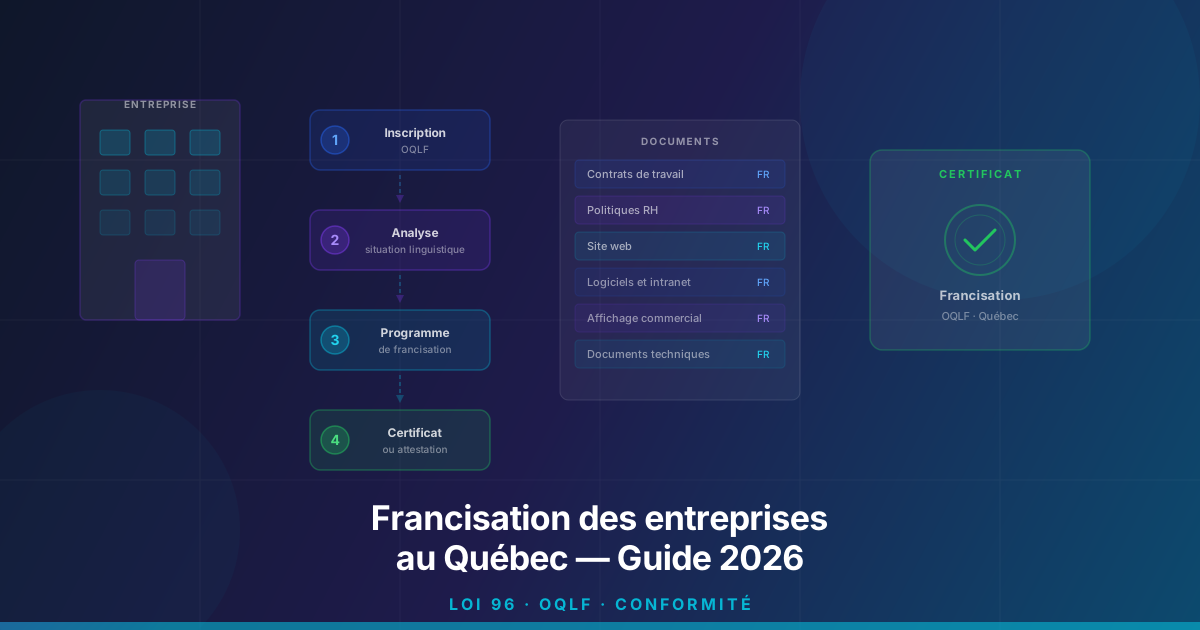
Bill 96 Checklist for U.S. Exporters Selling into Quebec (2026)
A practical Bill 96 checklist for U.S. companies selling into Quebec: packaging, labels, websites, ads and trademarks — what French is required, and the fines for getting it wrong.
Why U.S. Companies Choose a Canadian Translation Agency in 2026
Canadian French ≠ France French. Why U.S. companies hire a Canadian translation agency: native Quebec French, Bill 96 compliance, CAD billing and nearshore time zones.