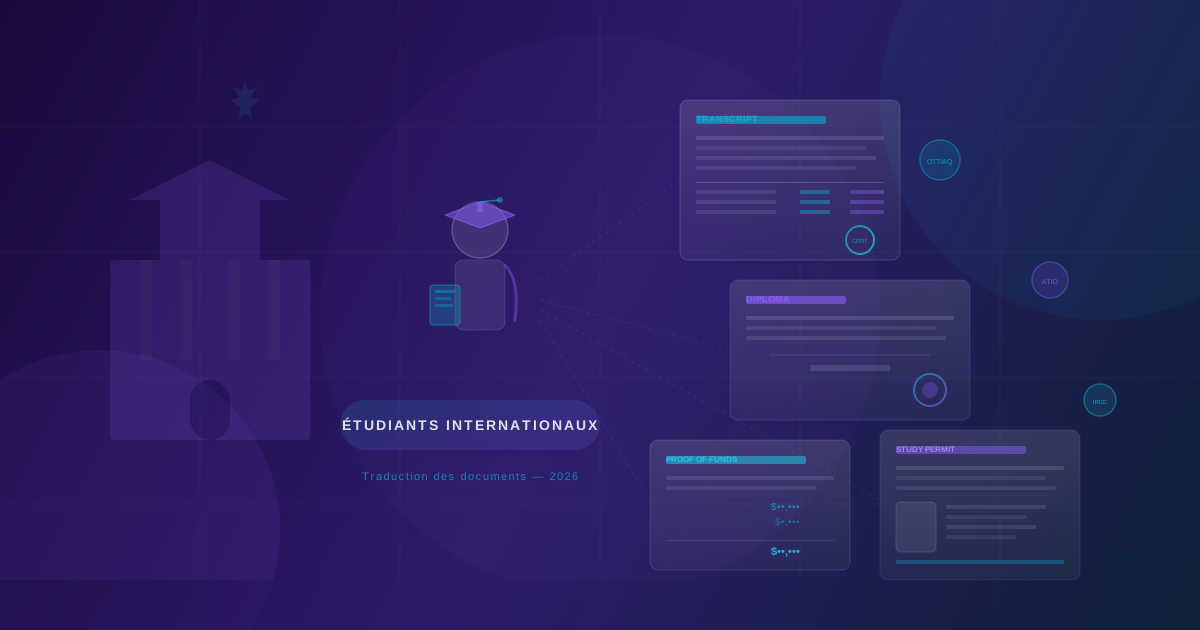
International Students in Canada in 2026: Which Documents Need Translation for Study Permit, CAQ and University Admission?
International students: complete guide to translating documents for Canadian university admission, Quebec CAQ and study permit applications.
An international student preparing an application for Canada often needs to have transcripts, diplomas, proof of funds, police certificates, or family documents translated — depending on the educational institution, the provincial program, and IRCC requirements. This guide explains which documents are involved, at which stage of the process, and with what certification.
In brief — To study in Canada, an international student must prepare documents for up to three recipients: the educational institution, IRCC, and in Quebec, the MIFI for the CAQ. Documents not in English or French may require a certified translation by a translator who is a member of a recognized Canadian provincial association, such as OTTIAQ in Quebec, ATIO in Ontario, STIBC in British Columbia, or another recognized provincial body. Since the Student Direct Stream ended on November 8, 2024, all study permit applications go through IRCC's regular process. In 2026, applicants must also account for the national study permit cap, proof of funds requirements, and in Quebec, the CAQ, which also serves as a provincial attestation letter (PAL).
How many international students is Canada accepting in 2026?
Canada has significantly tightened its International Student Program since 2024. The number of study permit holders dropped from over one million in January 2024 to approximately 725,000 by September 2025, according to IRCC.
For 2026, IRCC expects to issue up to 408,000 study permits, including:
- 155,000 to newly arriving international students;
- 253,000 extensions for current and returning students.
This total is 7% lower than the 2025 target of 437,000 and 16% lower than the 2024 target of 485,000.
Provincial or territorial attestation letter (PAL/TAL): since 2024, most study permit applicants must obtain an attestation letter from their province or territory before applying to IRCC. In Quebec, the CAQ for studies fulfils this role. PAL/TAL exemptions in 2026:- master's and doctoral students enrolled at a public designated learning institution (DLI);
- primary and secondary school students (kindergarten to grade 12);
- certain Government of Canada priority groups;
- existing study permit holders applying for an extension at the same DLI and at the same level of study.
This data comes from IRCC's official notice dated November 25, 2025.
What this means for translations: a more competitive environment means more rigorous applications. Well-prepared, properly translated documents submitted on time reduce the risk of refusal or requests for additional information.What is the difference between admission, CAQ, PAL/TAL, and study permit?
An international student's path to Canada involves several distinct steps. Each has a different recipient and potentially different translation requirements.
| Step | Quebec | Other provinces | Who decides? | Possible translations |
|---|---|---|---|---|
| Admission | Apply to the institution | Apply to the institution | The university or college | Transcripts, diplomas, letters, as required |
| CAQ for studies | Required before the study permit | — | MIFI (Quebec) | Per MIFI list; most in FR/EN, otherwise translation required |
| PAL/TAL | The CAQ serves as PAL | Required except for exemptions | Province or territory | Varies by province |
| Study permit | After obtaining CAQ | After obtaining PAL/TAL (if required) | IRCC (federal) | Supporting documents not in FR/EN |
Which documents need translation for university or college admission?
Canadian educational institutions set their own admission requirements. There is no single universal list. However, the following documents are frequently requested:
- academic transcripts — for each relevant year of study — transcript translation;
- diplomas and certificates of completion — diploma translation;
- ranking attestations or class standing certificates;
- letters of recommendation;
- course syllabi — sometimes requested for equivalency assessment;
- internship or work experience documents;
- publications — for doctoral applications.
Which documents need translation for the Quebec CAQ?
The Quebec Acceptance Certificate (CAQ) for studies is issued by the MIFI. It is mandatory for studying in Quebec and also serves as the provincial attestation letter (PAL) for the study permit application to IRCC.
The application is submitted online through the Arrima platform. The following documents are generally required:
- valid passport;
- letter of admission from a Quebec institution that meets MIFI requirements;
- tuition fee information;
- proof of financial capacity — depending on the applicant's country of residence;
- previous CAQ, if applicable;
- identity and family documents as needed.
For detailed MIFI requirements, see our complete guide to certified translation for the MIFI.
Which documents need translation for the IRCC study permit?
The study permit is the federal authorization issued by IRCC. It is required for any study program longer than six months in Canada. The following supporting documents are frequently requested:
- letter of acceptance from a designated learning institution (DLI);
- PAL/TAL or CAQ depending on the province, except for exempt groups;
- proof of funds — see the following section;
- valid passport — passport translation if requested;
- letter of explanation — written by the applicant;
- family documents as applicable (birth certificate, marriage certificate) — birth certificate translation;
- police certificate if requested — police record translation;
- medical examination if required — through an IRCC-designated physician.
For general IRCC translation requirements, see our complete guide to certified translation for Canadian immigration.
How to translate proof of funds for a student application?
IRCC requires applicants to demonstrate they have sufficient financial resources to cover tuition, living expenses, and transportation. The required amounts are published on IRCC's official proof of funds page and are updated each year. For Quebec, the applicable amounts are those published by the MIFI.
Common proof of funds documents:
- bank statements — for the past 4 months;
- bank attestation letter;
- letter of financial support from parents or guarantors;
- proof of income from the guarantor;
- Guaranteed Investment Certificate (GIC) from a participating Canadian financial institution;
- proof of scholarship;
- proof of student loan;
- bank draft convertible to Canadian dollars.
- amounts must be faithfully reproduced in the original currency;
- the account holder's name must match the passport exactly;
- bank stamps, handwritten notes, and official mentions must be translated;
- dates must be recent — an outdated statement may be rejected;
- if the guarantor is a parent, the letter of financial support may need translation.
Do I need to translate a police certificate or medical certificate?
Police certificate: IRCC may request a police certificate for each country where the applicant has lived for six months or more since age 18. If this document is not in English or French, it must be accompanied by a compliant translation. The document must be recent, according to IRCC requirements.- Some countries issue police certificates directly in English or French.
- Multiple countries of residence may require multiple certificates to translate.
- Processing times vary depending on the local authority in each country.
What are the specifics by country of origin?
The documents to translate and the points to watch vary by issuing country. Here is an overview of the most common situations:
| Country or region | Common languages | Documents often needing translation | Points to watch |
|---|---|---|---|
| France | French | Rarely, unless destination is anglophone | Bilingual seals or appendices to check |
| Morocco | French, Arabic | Arabic transcripts, police certificate | Bilingual FR/AR mentions must be fully translated |
| Algeria | French, Arabic | Arabic transcripts, civil status documents | Seal formats vary |
| Tunisia | French, Arabic | Arabic transcripts, police certificate | Apostille sometimes requested depending on destination |
| Senegal | French | Rarely for language, but format varies | Check seal legibility |
| Ivory Coast | French | Rarely for language | Non-standard transcript formats |
| China | Chinese (simplified) | All academic and civil status documents | CHESICC verification often required by WES |
| India | Hindi, English, regional languages | Transcripts in Hindi or regional language | Formats vary by state and university |
| Iran | Persian (Farsi) | All documents | Variable police certificate processing times |
| Vietnam | Vietnamese | All academic documents | Grading system differs from Canada |
| Brazil | Portuguese | Transcripts, diplomas, police certificate | Transcript formats vary by university |
| Ukraine | Ukrainian | All documents | Geopolitical situation may affect processing times |
See also our article on Chinese, Mandarin, and Cantonese translation in Canada and our guide to apostille in Canada.
How much do translations cost for a student application?
The cost depends on the source language, volume, number of documents, legibility, and desired turnaround. Here are indicative ranges:
| Application type | Typical documents | Indicative range |
|---|---|---|
| French or already FR/EN application | Little or no translation needed | Minimal |
| Maghreb FR/AR application | Arabic transcripts, police certificate, civil status | Moderate |
| Chinese application | All academic and financial documents | Higher (volume + rare language) |
| Iranian application | All documents | Higher (Persian) |
| Vietnamese application | All academic documents | Moderate to high |
| Master's or doctoral application | Transcripts, publications, syllabi, recommendations | Varies by volume |
| Application with extensive proof of funds | Multiple bank statements, support letters | Varies by page count |
What timeline should I plan before the start of classes?
Preparing a study application for Canada takes several months. Here is an indicative timeline:
| Step | When? | Translation-related actions |
|---|---|---|
| Program selection | T-9 months | Identify documents required by each institution |
| Applications | T-7 months | Translate transcripts, diplomas, and letters for admission |
| Academic documents and ECA | T-5 months | Order WES/ECA evaluation if needed |
| CAQ (Quebec) or PAL/TAL | T-4 months | Translate documents required by MIFI or province |
| Study permit (IRCC) | T-3 months | Translate proof of funds, police certificate, and family documents |
| Final checks | T-1 month | Verify consistency and validity of all translations |
How can a student pathway lead to PGWP, PEQ, or permanent residence?
A study permit is often just the first step. After graduation, several transition pathways to permanent residence are available:
- PGWP (Post-Graduation Work Permit) — allows working in Canada after studies, under certain conditions. Documents used for the study permit may be reusable.
- PEQ (Quebec Experience Program) — for Quebec graduates. Requires additional documents for the MIFI, often in French.
- Express Entry / CEC — after Canadian work experience. An ECA by WES or another organization may be required at this stage.
- PNP (Provincial Nominee Program) — depending on the province of residence after studies.
See also our guides on certified translation for the MIFI, certified translation for IRCC, foreign diploma evaluation, and family sponsorship in Canada.
How does Asiatis support international students?
Asiatis supports students and their families with document preparation for studying in Canada:
- document audit to identify what needs translation for the institution, CAQ, and IRCC;
- certified translation of transcripts, diplomas, police certificates, and proof of funds;
- certified translators who are members of recognized Canadian provincial associations;
- expedited service based on translator availability;
- multilingual coordination for applications involving multiple languages;
- confidentiality for financial and personal documents;
- grouped quotes for applications with multiple documents.
Asiatis is a translation and document preparation partner. We do not provide immigration advice and we do not guarantee acceptance of an application by IRCC, the MIFI, or any educational institution.
For a quote or to identify which documents need translation, contact us. See also our certified translation for immigration page and our immigration services page.
FAQ
Do I need to translate my transcripts if my Canadian university already accepts them?
Not necessarily for admission, if the institution has confirmed it accepts your documents in their original language. However, IRCC or the MIFI may require a translation of the same documents for the study permit or CAQ. Check the requirements of each recipient.
Does the CAQ require the same translations as IRCC?
No. The CAQ (MIFI) and the study permit (IRCC) are two distinct steps with document requirements that may differ. Some documents translated for the CAQ can be reused for IRCC, but always verify the instructions for each program.
Do my proof of funds need translation if they are in a foreign currency?
Translation concerns the language, not the currency. If your bank statements or attestations are in a language other than English or French, they must be translated. Amounts in foreign currencies are reproduced as-is; currency conversion is not the translator's responsibility.
Can I use a translation done in my home country?
It depends on the recipient. IRCC requires translations that comply with its standards — ideally performed by a certified translator who is a member of a recognized Canadian provincial association, or accompanied by an affidavit. A translation done abroad may not be accepted if it does not meet these requirements.
Is the Student Direct Stream still available in 2026?
No. The Student Direct Stream (SDS) and the Nigeria Student Express ended on November 8, 2024. All study permit applications now go through IRCC's regular process.
Does the MIFI accept ATIO translations or only OTTIAQ?
The MIFI requires a translation by a recognized translator, with the translator's name and seal on the document. OTTIAQ is the Quebec professional order for translators and is often the safest and most natural choice for Quebec-bound applications. The MIFI does not publish an exclusive list of accepted associations, but applicants should always verify the exact requirements with the MIFI or the receiving institution.
Do I need to translate my passport?
IRCC does not systematically require passport translation. However, if the identity page contains information not readable in English or French (seals, handwritten notes, appendices), a translation may be helpful. Check the instructions for your specific application.
Do I need to apostille my diplomas before applying for a study permit?
Not in most cases. An apostille is generally not required by IRCC or the MIFI for a study permit application. It may be relevant if your documents must be used in a country that is a member of the Hague Convention. See our guide to apostille in Canada.
What should I do if classes start soon and my translations are not ready?
Start by identifying the priority documents for your application submission and have those translated first. Some providers offer expedited service based on translator availability. Also inform your host institution of any potential delay.
Will translations done for my student application be usable later for PEQ, Express Entry, or WES?
In most cases, yes. A certified translation by a translator who is a member of a recognized Canadian provincial association is generally reusable for other immigration steps (PEQ, Express Entry, WES, IRCC). Keep your originals and translations carefully.
---
To prepare your study application for Canada with professional document support, contact Asiatis. See also our certified translation page, our IRCC guide, and our MIFI guide.
Get a Free Quote
Our certified translators are ready to help. Response within 2 hours.
Request a Quote →Related articles
Bill 96 Checklist for U.S. Exporters Selling into Quebec (2026)
A practical Bill 96 checklist for U.S. companies selling into Quebec: packaging, labels, websites, ads and trademarks — what French is required, and the fines for getting it wrong.
Why U.S. Companies Choose a Canadian Translation Agency in 2026
Canadian French ≠ France French. Why U.S. companies hire a Canadian translation agency: native Quebec French, Bill 96 compliance, CAD billing and nearshore time zones.